Imitated Content in the AI Era—and Delivery Beyond Text
When I open X, I sometimes see scenes like this.
A creator drops a post that goes viral. Hundreds of thousands of impressions. Then, hours later, a post with the same theme and phrasing—yet looking as though it came from an entirely different hand—appears on another platform. It might be note, it might be Qiita, it might be another X account. The original source isn't linked. But the moment you read it, you know. "Ah, this is that post."
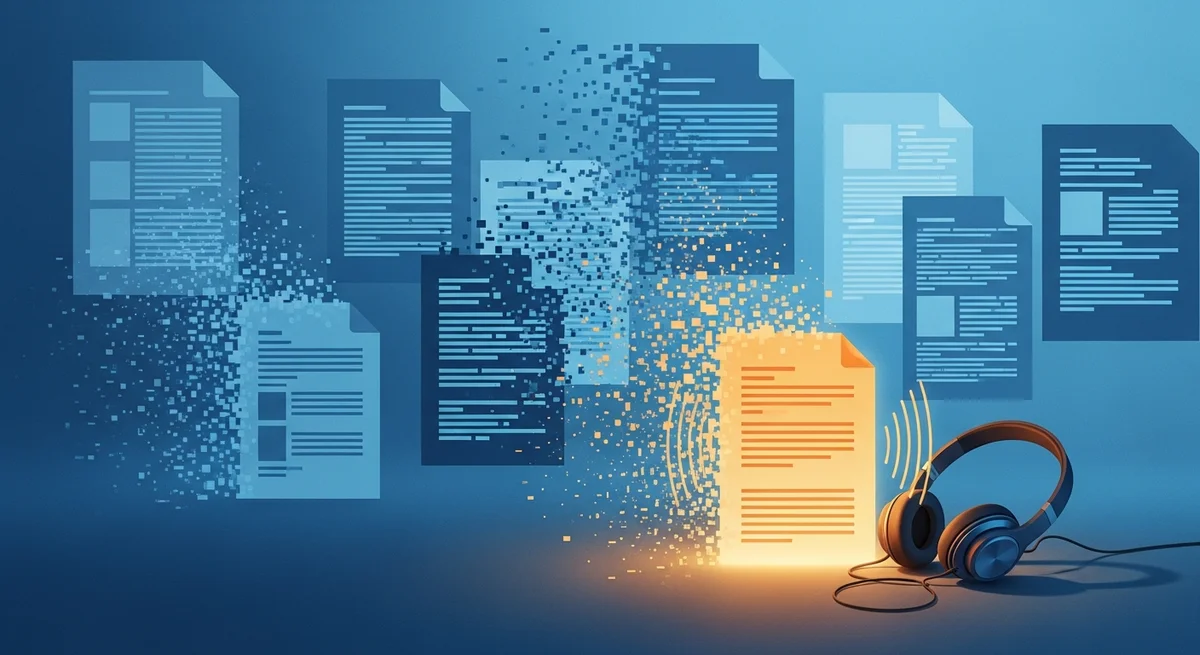
The boundary between imitation and reinterpretation has, for all practical purposes, disappeared. Style and theme can be reproduced in a few clicks. What remains for publishers is thought, context, and delivery beyond text.
I've observed the structures of content distribution and monetization from both sides: publisher-affiliated media and advertising. Right now I'm building an article-to-audio SaaS, but the subject of this piece is imitation. I won't pitch the product here.

How AI Changed the Cost of Imitating a Writing Voice
The templating of custom instructions and system prompts in AI tools—mechanisms like Claude's Skills that package instructions and reference materials together—is, at its core, a set of prompts. Define a particular writing voice, vocabulary choices, sentence rhythm, and paragraph structure as a set of rules, and anyone can generate prose in that voice.
What this means is that you can reproduce a viral creator's "way of writing" in a few clicks. The choice of topics, the tone of address, the article's structural template. Bundle these into a Skill, and all you have to do is pour in raw material—and you can mass-produce content that looks and sounds close to the original creator.
With the X API, acquiring first-party information is essentially real-time. An insight or data point someone posts can be pulled out directly as "raw material." I myself use AI tools to keep my blog's writing voice consistent; I'm on the side of letting the tool assist with structure so the content stays coherent. This is by no means an unusual usage, and I suspect many publishers are already doing the same.
The breakwater of a distinctive writing voice is effectively disappearing. At least in the realm of text.
74% of New Pages Contain AI-Generated Content
Let me back this with numbers. According to a large-scale study released by Ahrefs in 2025 (analyzing roughly 900,000 English-language web pages newly published in April 2025), 74% of newly published web pages contain some form of AI-generated content. Looking at the breakdown, however, fully AI-generated pages account for only 2.5%; the remaining 71.7% are a hybrid of human and AI.
The problem here is not "AI involvement" itself. It is that writers without first-hand experience can now mass-produce plausible text. Even when a human writes it, prose from someone who does not know the field is indistinguishable to the reader from prose generated by AI. If they are indistinguishable, then the format of text itself loses scarcity.
The Shelf Life of First-Party Information Has Become Instantaneous
Even in the SEO world, the value of first-party information is rising. In Google's Search Quality Rater Guidelines, the element placed at the center of E-E-A-T (Experience, Expertise, Authoritativeness, Trustworthiness) is Trust, with Experience, Expertise, and Authoritativeness positioned as the elements that support it. The January 2025 revision added definitions for generative AI and descriptions concerning the abuse of scaled content, strengthening the lens through which raters discern whether content is grounded in first-hand experience. E-E-A-T has always been an evaluation concept applied to all queries, with particularly high standards demanded in areas carrying significant financial or health-related risk (YMYL); in the AI era, the presence or absence of first-hand experience is now weighted more heavily across every domain.
Conversely, the value of a "citation" from someone who actually holds first-party information has never been higher.
This is exactly why the moment you release valuable first-party information on X, its shelf life collapses all at once. A viral post is retrieved instantly via the API and "reconstructed" on another platform. All a third party has to do is compile the X posts, add a little context, and publish on a different outlet. The barrier is vanishingly low.
This structure itself is not particularly new. In the past, it was common to see Japanese bloggers translate and turn into articles what overseas influencers had said on YouTube. Across the filter of the language barrier, imitation was practiced under the name of "translation and reinterpretation."
AI removed that filter. The language barrier, the stylistic barrier, the time barrier—everything was stripped away. What remained was the single fact of "whether or not there's an original source." Yet even that fact has grown difficult to read from the surface of the content.
The line between imitation and reinterpretation is already gone.
AI Overviews Reduce the CTR of the #1 Ranked Page by 58%
There is another figure that accelerates the imitation problem. A 2026 follow-up study by Ahrefs found that when Google's AI Overviews (AI-generated search result summaries) are displayed, the average click-through rate (CTR) of the #1 ranked page drops by 58% (worsening further from 34.5% as of April 2025). Because AI summarizes the answer at the top of the search results, readers have less motivation to make it through to the original article.
For first-party information publishers, this is a double blow. Not only are they beaten to the punch by imitation content, but AI search itself reduces the inflow of readers. As it grows hazier "whose content" a citation originates from, "who said it first" becomes ever harder to see.
With Text Imitation Now Easy, What Remains for the Publisher
Beyond "who said it first," what actually remains?
Functionality can be copied. A writing voice can be copied. Topic selection, structural templates, the instinct for timing a post—these can probably all be copied too. Especially with AI in hand.
Conviction and context cannot be copied. A single line written by someone who has spent a long time grinding away in the same industry carries a different density in its background than a piece that lifts only that line and reuses it. The accumulation of experience, the fact of persistence, the relationship with readers—these are not lost just because they were imitated once.
But to be honest, I'm not yet certain these are robust enough to be called an "advantage." Imitation content can reach readers before the original does. Neither search ranking nor follower count guarantees that the "real thing" wins.
Here is one easily overlooked fact: the format of text itself is the medium most vulnerable to imitation. Text can be reproduced with copy and paste. Regenerated with AI. Retrieved via an API. In other words, as long as you keep publishing in text, you cannot escape the wave of imitation.
If that's the case, then possessing a means of delivery other than "reading" may become a survival strategy for publishers.
Audio Has Not Yet Felt the Impact of Text Oversupply
Text is easy to copy. Word for word, structure, style—all of it is trivially reproducible in the digital world.
Audio is different.
The quality of the voice, the placement of pauses, the warmth of the delivery, the timing of breaths—reproducing all of these word for word is incomparably harder than imitating text. On the technical side, multiple services can now generate a voice clone from just a few dozen seconds of audio sample, and the harm caused by unauthorized cloning has become a social issue. However, unauthorized cloning is increasingly subject to legal regulation and the policies of distribution platforms in various countries; it is no longer a domain where things "can be done at scale in a gray zone" the way text reuse can. Whereas text imitation is effectively costless, unauthorized reproduction of voice carries reputational and legal costs.
There is another thing audio can do that text cannot: reach people during the commute, while doing housework, while exercising—times when the eyes and hands are occupied but the ears are free. Content that reaches people during this time is not riding the wave of text oversupply. According to The Infinite Dial 2026 (2026), an estimated 167 million Americans aged 12 and older listen to a podcast at least once a month. Notably, the online audio listenership rate among those 55 and older jumped 18 points in two years, from 52% in 2024 to 70% in 2026.
Demand for listening exists. The supply—delivering articles as audio, as they are—has not yet caught up.

For article-to-audio offerings aimed at media, I've heard multiple reports from adopting organizations that dwell time and repeat-visit rates have moved. I've written about the numbers and mechanisms in detail in a separate article, so I'll omit them here. What I want to write about here is purely the imitation angle.
What a text copy struggles to strip away—the quality of the voice, the pauses, the speaker's own voice clone—tends to remain on the audio side. A third party mass-producing different content unauthorized, in "that person's voice," means something different from reusing text.
If you rely solely on text, the imitated party ends up "fighting on the same stage." Meanwhile, audio still carries a high cost of imitation, and the publisher's voice and sense of pacing tend to survive. Even for the same article, adding one more delivery route changes the slice of readers you can reach. As imitation accelerates, whether or not you hold a route beyond text may become the branching point for publishers.
Brand Mentions Correlate More Strongly Than Backlinks
In the AI search era, there is another axis.
According to an Ahrefs analysis (covering roughly 75,000 brands), visibility in AI search (ChatGPT, Google AI Overviews, etc.) correlated more strongly with brand mentions (mentions on Wikipedia, Reddit, YouTube, LinkedIn, and so on) than with backlinks. Inbound links—the metric prized in traditional SEO—still showed a positive correlation, but in AI search the weight of "where you're being talked about" appears to be rising relatively.
In other words, in the AI era the strongest breakwater against imitation is shifting toward "how much that person or brand is mentioned on outside platforms." The viral first-party information itself may be imitated within hours, but stealing the brand recognition of "so-and-so said it" is far harder than copying text.
The fact of keeping delivery cannot be copied
I won't deny that content publishing may become "part of a hobby." If text imitation accelerates further, that is probably what will happen for publishers who can't sustain any distinctiveness and merely channel information along.
But the option of changing how you deliver is still there. The hours when the ears are free are still untouched by the impact of text oversupply. The value of content that reaches people during those hours can be measured on a different axis from text.
Even as imitation accelerates, the fact that you keep delivering cannot be copied. I'd like to believe that fact still holds a little more value.
Related articles
- Why we built an AI audio SaaS for web media — Why we turned non-text delivery into a product
- What changes when web media articles are turned into audio — Deployment data on dwell time (limited measurement)
- Why Web Media Ad Revenue Stagnates: Dissecting 3 Structural Problems — The structural limits of display advertising
- A field comparison of web media article audio services, by people on the ground — Selection axes from onboarding through analytics to monetization
