Why We Built an Audio SaaS for Web Media
Why did I leave the advertising world to build a SaaS that turns articles into audio? In one line: because I wanted to add one more route for delivering content. What follows is how I arrived at that decision.
"Just add one more slot, and you'll see this much monthly growth"
This is from around 2015. I was working on monetization and data analysis for large-scale websites at a major publisher-affiliated media company. I would often make proposals like this to the media managers: "If you add one more ad slot here, your monthly revenue will grow by about this much." My estimates were usually right. So the slots would get added. Mid-scroll on the page, between articles, below the footer. The slots kept multiplying.
This was the dawn of programmatic advertising, a period when the shift to RTB (Real-Time Bidding) was accelerating. According to eMarketer, around 60% of US display ad spend was already programmatic by 2015. The same trend was hitting Japan, and media companies were caught in a dilemma: "the more slots we add, the lower the unit price drops, but the total still goes up."
The same loop keeps spinning, with increasing intensity. Ad rates fall, so you add more slots. More slots means a worse user experience. A worse experience means shorter dwell time. Shorter dwell time means rates fall again. Inside this loop, both the media side and the ad side are each making rational decisions to protect their own businesses. It's just that the accumulation of those rational decisions produces an irrational result for the whole. I've revisited this structure in Why Web Media Ad Revenue Stagnates: Dissecting 3 Structural Problems.
I'm someone who has made a living in advertising. As someone who worked hands-on with ad operations, when ITP (Intelligent Tracking Prevention) arrived, it landed like a body blow. Cookies stop working. Audience precision drops. Advertisers lose enthusiasm to spend. Media revenue erodes from the inside.
This structure is still with us today.
After ads, what does a media company hold onto?
After that, I also worked on the SSP and ad network businesses, and this time I stood on the ad infrastructure side. I was in charge of monetization support for programmatic advertising and the data analysis around it.
My perspective shifted. When I was at the ad company, the question was "how do we grow media revenue?" On the media side, it became "how do we grow revenue while protecting the editorial team's motivation and the reader experience?" These two don't reconcile easily.
To be honest, I saw the limits of ad-dependent media operations many times in the field. When PV (page views) go up, ad revenue goes up. So you chase PV. To chase PV, you make headlines a little more sensational. You split articles into smaller pieces. You use recommendation widgets to circulate readers within your own site. How many seconds does a reader stay the moment they open a page? How does CTR (click-through rate) distribute? When you stare at those numbers every day, before long you stop seeing "readers" and start seeing "traffic."
Speaking from my own experience making growth-hacking proposals, the moment you report "this measure lifted CTR by X%" is genuinely satisfying. But I also know how many editors behind those numbers agonize over "is this headline really okay?" In media workplaces, the job is always done side by side with dilemmas.
Nobody is doing anything wrong. Media companies have to sustain themselves as businesses. Editors have to pay the salaries of the people writing articles. Server costs pile up too. So maximizing ad revenue is a rational decision for keeping the business going.
But it's also a fact that, as a result, the reader experience gets squeezed. I imagine you've had the experience of opening a news article on your phone and seeing ads more prominent than the main text.
As someone who's been inside the industry, I know this isn't because someone is being malicious, or because media has grown corrupt. It's happening structurally.
Keeping one more delivery route beyond "reading"
In May 2025, I founded Media Leap Inc.
There were a few direct triggers for starting the company. Generative AI reached practical maturity and the cost of speech synthesis fell to a fraction of what it was a few years ago. On the infrastructure side, the support I received through the Google for Startups Cloud Program was a source of reassurance. But I think the underlying motive was simpler, and more accurate to describe as wanting to solve a question that had lingered in the back of my mind for a long time.
Having worked on both the ad company side and the media side, there was one thing I felt consistently: "the value of content" and "the route it reaches people" are separate problems. No matter how good an article you write, if the only delivery route is "text read via search and social," there's a ceiling on how many people it can touch. Commuting, walking, doing housework — if there were a route that reached people during those "eyes-busy" moments, the value of the content would expand accordingly.
"Information, depending on how it's delivered, can change people's behavior."
This is a phrase I hold as a business conviction, but ever since my days doing data analysis on the media side, one thing had always bothered me. Quality articles weren't reaching people. The moment they're published, they get a little distribution on social media, but within a few days they survive only on long-tail search traffic. Meanwhile, audio content like podcasts and radio is woven into daily life as a habit people enjoy while commuting or doing housework.
According to a joint survey by Otonaru and the Asahi Shimbun Company (6th Podcast Usage Survey in Japan, published February 2026), monthly podcast usage in Japan is 18.2%. It has grown steadily from 14.2% in 2020, but still lags behind the 58% figure in the US (Edison Research, The Infinite Dial 2025). Notably, it reaches 40.5% among 15-19 year olds, and the base is broadening, centered on younger age groups. But behind that, the act of "listening to news or articles in audio form" is already something many people do, through read-aloud features in reading apps and news narration on smart speakers.
In other words, the demand is there. It's likely just that the supply side hasn't caught up.
Even looking at my own experience, I feel the same thing. Fifteen minutes washing dishes, twelve minutes walking to the station. During those times, even if I open a text article, I can't keep reading. My hands are occupied so I can't scroll, and I can't keep looking at the screen. But I can listen to a podcast. The hours when the ears are free are already there. Text media simply has not reached into those hours yet.
"Reading" and "listening" aren't in a hierarchy; they sit side by side. Some people are better at reading text, others prefer to listen with their ears. The same article, just by changing how it's delivered, reaches a different layer of people. If that's the case, then a media structure that depends solely on "being read" is, I think, a wasteful structure.
The changes we're seeing at deployed customers
PUBVOICE is a SaaS that uses AI to automatically convert web media articles into audio. It covers everything from article retrieval to audio generation and player embedding. I'll leave the detailed feature comparison to a separate article.
At some deployments, we are seeing changes in dwell time and repeat rate. The numbers and the measurement premises (limited measurement, not an A/B test) are laid out in detail in What Changes When Web Media Adds Audio to Articles, so please read that piece. What I want to write here is not the figures themselves but which of the changes was the least expected.
The number that surprised me most was the repeat rate.
The dwell time increase was predictable, I think, because more people read the article while listening to the audio. The PV increase, I believe, is because a pathway was created that leads from the audio player to other articles. But the repeat rate going up was unexpected.
When we analyzed it, we could see a movement of readers who listened to the audio coming back to "listen again." The trigger for visits was shifting from search referrals toward habitual playback. Change the delivery method and the quality of the relationship changes. This structure, I feel, is exactly what I had been wanting to see.
Some media companies use voice cloning to carry the editor's actual voice. The article arrives in the voice of the person who wrote it. A shift in distance that never emerged with text alone shows up in the feedback.
Why we didn't go with an ad-supported model
About PUBVOICE's pricing design, I'm often asked: "Couldn't you put ads inside the player and offer it to media for free?"
In practice, we could have designed it that way. Insert audio ads into the player, and media companies could use it for free while we earned from ad revenue. For someone who spent a long time in advertising, it's a familiar model.
But I chose not to. If I were going to rotate back to "adding more ads," there would be no point in building this product. Adding slots and increasing the value of existing slots are different things. I wanted to build a tool for the latter.
That's why we settled on a structure in which media companies bear the cost. We offer a Free plan, but serious use moves to a paid plan (from 1,480 JPY/month). This was not an easy choice. The weight of discussing monthly running costs with media teams as they scrape together the budget reverberates, slowly.
Saying "I don't want to add more ads" while charging a fee means I have a responsibility to deliver results that justify it.
The experience of "reading while listening"
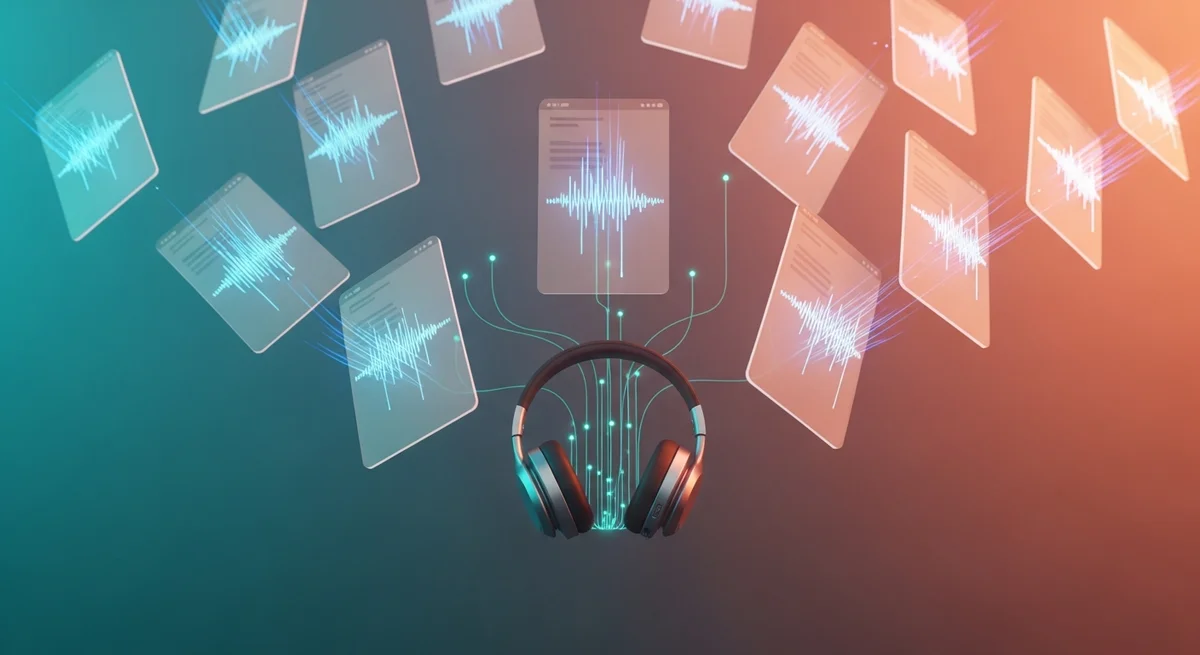
PUBVOICE's audio does not summarize the article. It understands the article's context and structure (headings, bullet lists, tables) and rewrites it into an ear-friendly script before generating audio. Expressions that assume vision, like "see the figure above," are converted into natural spoken language. The article's arguments and information are preserved in full; only the delivery is optimized for the ear. In other words, audio is not a replacement for text; it exists alongside text.
This is a decisive difference from services that turn articles into video. Video occupies the screen, so it becomes a replacement for text. Only audio can be consumed simultaneously with text. The experience of "reading while listening" is a perspective other providers do not emphasize much, but it is the one I consider most important.
Why does the "read while listening" experience matter? Reading speed gets guided by the audio, making drop-off less likely. It reaches readers with visual difficulties and readers learning Japanese. And because the reader keeps looking at the screen while listening, the time the ad slots outside the first view are viewed also grows. There is a path here to raise the value of existing ads without adding more. I have laid this out separately in another article.
It's simply about adding one more delivery route
Writing this far, a thought comes back to me.
The reason I built PUBVOICE is not to save web media. The revenue challenges of media are not simple enough to be solved by audio alone, and I knew that from the moment I started the business.
What I wanted to build was a way to add one more route for delivering content. To make it easy for media to hold a delivery method other than being read by the eyes. To bridge the gap between writer and reader through the form of audio. And as a result, if it opens up even a slightly better path to reducing dependence on ads, that's fine too.
I think it's enough to frame it like this: PUBVOICE exists as a tool that supports that change.
There's also the reality of solo founding, where the days I open the dashboard in the middle of the night and sigh are more frequent. It's also true that we haven't reached the user numbers or the revenue I projected for the one-year mark. Even so, when I hear from deployed customers that "we received our readers' voices for the first time," I think maybe this direction isn't wrong.
The routes for delivering content are no longer text-only. How the media of the future will receive that fact — I want to keep watching.
Related articles
- Why Web Media Ad Revenue Stagnates: Dissecting 3 Structural Problems — The structural limits of ad revenue, with the latest data on ad blocking and platform oligopoly
- How we're thinking about raising the value of existing ad slots without adding more — How extended dwell time moves the value of existing ad slots
- What changes when web media articles are turned into audio — How dwell time and repeat rate moved with audio
- A field comparison of web media article audio services, by people on the ground — A comparison of BeyondWords, PUBVOICE, ReadSpeaker, and others
- Imitation in the AI era and delivery beyond text — What it means to hold a delivery route other than "reading" in the AI search era

Yutaro Sasao
CEO / MediaLeap Inc.
After leading web media monetization and data analytics at KADOKAWA / DWANGO, and driving programmatic ad revenue growth in SSP / ad network businesses, he founded MediaLeap Inc. in May 2025. He now develops and operates AI audio SaaS "PUBVOICE", tourism DX app "ANIME TRAVEL", and AI voice chat app "AITOMO". Drawing on cross-functional expertise in advertising, technology, analytics, and business, he works to improve media revenue through data-driven strategies.
Related posts
How We're Thinking About Raising the Value of Existing Ad Slots Without Adding More
Can we raise the value of existing ads without adding slots? A former 'add more slots' practitioner writes a working concept on dwell time, viewability, and attention metrics.
Imitated Content in the AI Era—and Delivery Beyond Text
With AI in 74% of new pages, text imitation costs near zero. What remains for creators is thought, context, and non-text delivery—voice, pacing, presence.
What Changes When Web Media Adds Audio to Articles
At some deployments that added AI audio to web media articles, dwell time averaged 3x, repeat rate +5%, and PV +5%. A practitioner from the media monetization field writes about the market data and the barriers to adoption.