
How We're Thinking About Raising the Value of Existing Ad Slots Without Adding More
I'm writing about what someone who spent a long time on the slot-addition side is thinking now.
As a means of growing ad revenue, the long-standing standard has been "add more slots." Put another banner above the article. Slip an in-feed ad into the body. Drop a rectangle in mid-scroll. Because the revenue projections for these are basically accurate, they have been the quickest way for the person on the ground to hit the monthly target. I myself have made this proposal many times.
However, facing the structural plateau in ad revenue, we are forced to consider paths other than "adding slots." What I am thinking about now is raising the value of existing ads without adding more slots. From the standpoint of someone who built a system to turn articles into audio, I want to lay out how far the logic holds.
Adding slots and raising slot value are different things
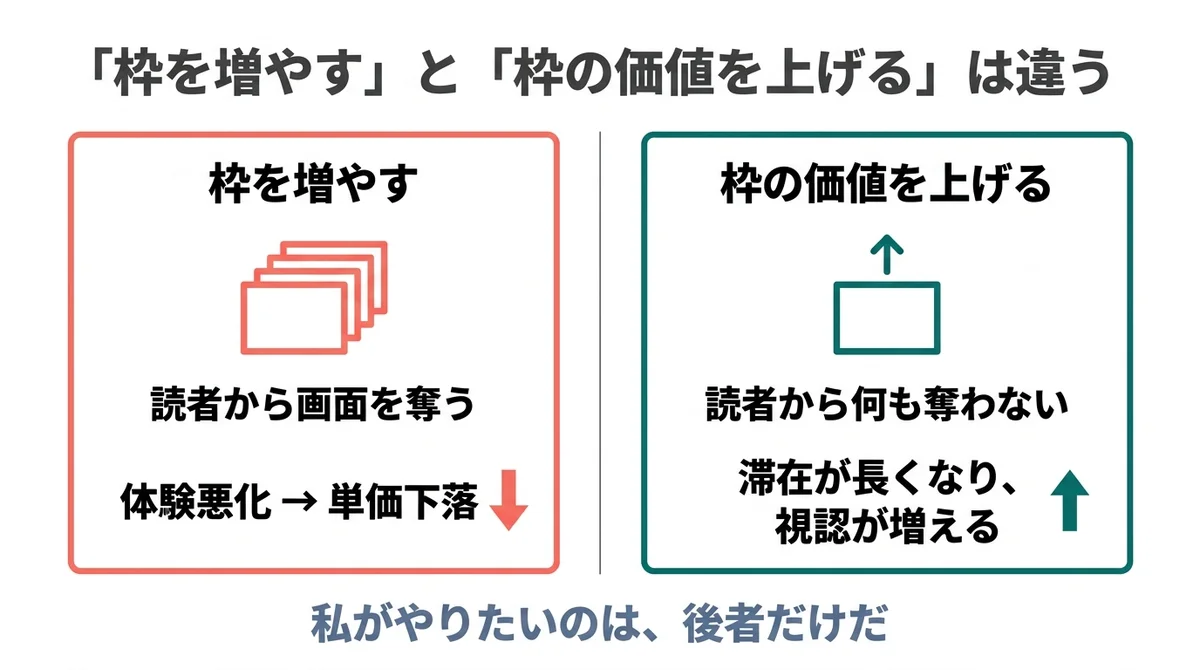
Let me start with the blunt version: these two are completely different acts.
Adding slots is the act of taking screen space away from the reader. As a result, the user experience is squeezed, dwell time shrinks, and you enter the loop of falling CPM. I laid this out in the previous article.
Raising the value of existing ad slots, on the other hand, takes nothing from the reader. It is not about adding a new ad to the screen; it is about making the slots that already exist be seen by the reader's eyes for longer and more reliably. These two are completely different acts. The only thing I want to do is the latter.
How does ad viewing move when dwell time grows?
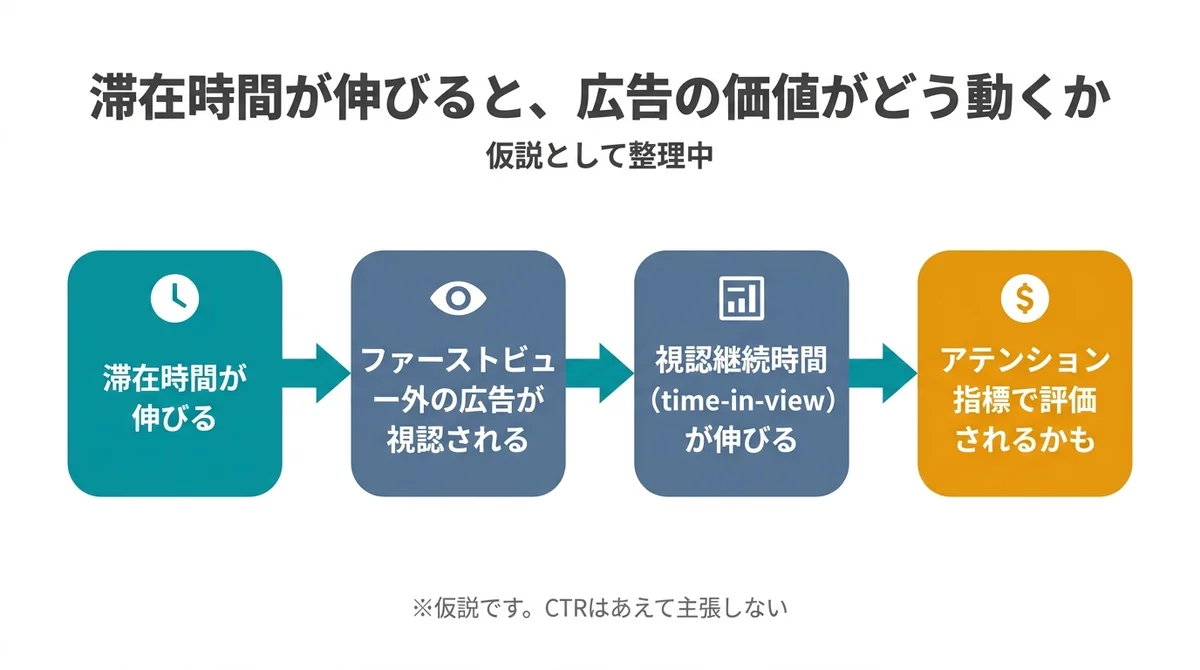
The MRC viewability standard judges a display ad as viewable when "50% or more of its area is displayed for 1 second or more." In other words, viewability is a threshold judgment, not a continuous quantity that gets better the longer the time.
That said, when dwell time grows, there are three things that can be accurately claimed.
- The probability that ad slots outside the first view (below the article, in the sidebar) are seen goes up. Readers staying on the page longer means a higher probability that they scroll down and reach those slots. As a result, the number of viewable impressions increases.
- The viewed duration (time-in-view) per impression grows. While the reader remains on the page, that slot continues to be displayed.
- For refresh-type slots, effective impressions increase. In a design where ads rotate at regular intervals, longer dwell means more displays.
These are not stories of "we added ads," but of "the same ads were seen more reliably and for longer."
Attention metrics as a bridge to CPM
In recent years, the concept of "attention metrics" has been spreading among ad buyers. Adelaide's AU and the average display time in Active View are representative examples. It is a movement to evaluate inventory not only by "whether the ad was displayed," but by "how long the reader's attention was directed at the ad."
In my observation, more and more buyers are adopting these attention metrics. If so, inventory with long time-in-view may be valued by such buyers. This is the core of the logic that bridges "dwell time grows" and "ad CPM rises."
However, this is a hypothesis, not a proven fact. How far the adoption of attention metrics progresses, and how directly the dwell-time lift from audio translates into improved attention metrics, depends on future measurement. At this point I am writing it as an observation that "things may move in this direction."
Impact on CTR
Readers who read an article while listening to audio are immersed in the content. The more immersed a reader is, the less they click on ads. In fact, in the data I see from deployments, while dwell time and repeat rate grow, I have not heard clear reports that ad CTR goes up.
So I do not claim CTR improvement in this concept. I focus on dwell time and viewed duration, and think about value through viewability and attention metrics.
Background playback and ad viewing
A reader who is listening to audio may not be looking at the screen. A "listen-while-doing-other-things" reader may have their phone in their pocket with only the audio playing. If viewability is being counted in that state, the numbers grow, but the ad is not being seen. That is just another version of "the numbers went up but the reality didn't match" that I myself contributed to in the past.
This is something that troubles me too.
That is exactly why PUBVOICE is designed on the following premise: measure "read while listening" sessions and "listen while doing other things" sessions separately. Clearly distinguish sessions where the reader is looking at the screen from sessions where playback is in the background. The viewability argument holds logically only in "read while listening" sessions. Counting background-playback time as dwell time and using it as the basis for ad value is, honestly, a stretch.
To be candid, this measurement separation is not fully implemented at this point. What I am writing in this article is a concept — "we are thinking with this design as the premise" — not a report that "it's already done." But to discuss ad value in a way that is not padding, I believe this distinction is essential.
Placing this here as a concept
What I have written in this article is, in every case, a concept — not a results report of implemented features.
- As dwell time grows, the probability and viewed duration of ads outside the first view grow (hypothesis)
- Against the backdrop of spreading attention metrics, inventory that is viewed for longer is more likely to be valued (observation)
- On the other hand, without separating background playback from screen-attention, it looks like "padding" (self-awareness)
As I also wrote in Why we didn't go with an ad-supported model, I have no intention of rotating back to the side that adds more ads. However, if there is a path to honestly push up the value of existing ad slots, that is another meaning that lies beyond audio.
For audio advertising itself, see the "About the author and PUBVOICE" section in the comparison article. For deployment decisions at this point, I think the framing of "retention and measurement as the main purpose" is appropriate.
Related articles
- Why Web Media Ad Revenue Stagnates: Dissecting 3 Structural Problems — The loop in which adding slots pushes down CPM
- What changes when web media articles are turned into audio — Deployment data on dwell time (limited measurement)
- Why we built an AI audio SaaS for web media — Why we did not choose an ad model
- A field comparison of web media article audio services, by people on the ground — Selection axes including the role of audio ads
- Imitation in the AI era and delivery beyond text — Why non-text delivery still matters

Yutaro Sasao
CEO / MediaLeap Inc.
After leading web media monetization and data analytics at KADOKAWA / DWANGO, and driving programmatic ad revenue growth in SSP / ad network businesses, he founded MediaLeap Inc. in May 2025. He now develops and operates AI audio SaaS "PUBVOICE", tourism DX app "ANIME TRAVEL", and AI voice chat app "AITOMO". Drawing on cross-functional expertise in advertising, technology, analytics, and business, he works to improve media revenue through data-driven strategies.
Related posts
Imitated Content in the AI Era—and Delivery Beyond Text
With AI in 74% of new pages, text imitation costs near zero. What remains for creators is thought, context, and non-text delivery—voice, pacing, presence.
What Changes When Web Media Adds Audio to Articles
At some deployments that added AI audio to web media articles, dwell time averaged 3x, repeat rate +5%, and PV +5%. A practitioner from the media monetization field writes about the market data and the barriers to adoption.
Three Structural Reasons Web Media Ad Revenue Stagnates
Oversupply of slots, ad blocking (29.5% globally), and platform concentration. Structural limits written from the inside by someone who worked both SSP and media sides.